
(August 28, 2023) Mama Lava challenges us regarding our language…
Words are essential every day… some describe feelings, others tell of actions.
1. Complaining Words
I’ve been thinking quite a bit about words.
Guess that is to be expected when starting to write something, especially a blog… What is the message I want to convey? How do I want to say it?

When I write, I can be thoughtful and intentional – I have the benefit of backspace. But spoken words can be harder to manage.
The poster-sized James 1:19 reminder to the right? I have it hanging in my house:
I intend for my audible words to withstand rigorous checkpoints before they get through my lips, but they often escape with astonishing ease. The Bible points out the inconsistency of my tongue very well: ‘With the tongue we praise our Lord and Father, and with it we curse human beings, who have been made in God’s likeness’ (James 3:9).
I can say something compassionate and kind – but follow it right up with something sarcastic and sassy. I can express gratitude with one breath – and complain in the next! And God shines His light on it, so I take notice and fix it.
2. Mocking Words
‘Mockers stir up a city, but the wise turn away anger’ says Proverbs 29:8.
Do you know what a mocker is? I must admit that some years back, I couldn’t correctly define it. Thank goodness for my Merriam-Webster –
- Mocker (n): a person who causes repeated emotional pain, distress, or annoyance to another.
- Words related: heckler, teaser, belittler, trash-talker, smart-alec, wiseguy, troublemaker, pest…
- Nearest opposite words: defender, guard, rescuer, comforter, champion…
What are your thoughts about these insights? I had to sit with them for a minute. I thought about the trash-talking I do during competitive events, the teasing I do for a laugh, and the smart remarks I throw around lest people dare to discount me.
Maybe, as far as words go, mocking ones don’t seem like the worst kind. But are they worth my breath, your breath? Proverbs 22:10ESB advises: ‘Drive out a scoffer, and strife will go out, and quarreling and abuse will cease.’

The Bible uses the words mock, mocker (or scoffer) several times and never in approving terms. How can I resemble the antithesis of a mocker? I’d like to champion people and spend the moments I have constructively to leave others comforted. I want to guard the dignity of those around me.
Our Saviour and great example, Jesus, certainly didn’t mock others!
Does this quick study strike a chord with you? Are there any old habits coming to mind that you’re going to change? Is there a new kind of vocabulary you’d like to expand in place of your mocking words?
3. Nurturing Words
‘Life-giving words’ has been a trendy hash tag du jour. You have likely come across it more than once. People throw the phrase around and it sounds noble, but it also raises the question – what does it mean? How can my words nurture life? Again I enlisted the trusty Merriam-Webster to shed some light:
- Nurture (v): to help the growth or development of…
- Words related: cultivate, promote, advocate, nourish…
- Nearest opposite words: prevent, hinder, oppose, encumber…
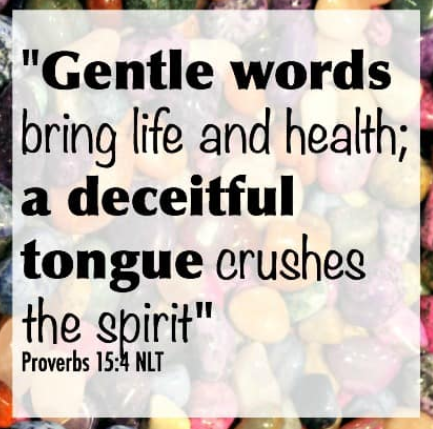
Proverbs 10:21a gives some more insight: ‘The lips of the righteous nourish many’ as does Proverbs 15:4, ‘The soothing tongue is a tree of life, but a perverse tongue crushes the spirit.’
What comes to mind when you contemplate the idea of nurturing? A mother with her baby? A gardener with a seedling? An animal in dire straits who is being nursed back to life by a wildlife preservation group? These are the things I think of. But how do those pictures translate into language?
Nurture is a verb. It implies a doing. How can my words take action in someone’s life? The beautiful thing about words is that they do have the power to take root in someone’s mind and grow into ideas and inspiration. That is also the awful thing about words. It all depends on which words I choose.
We’re familiar with the experience of having a voice from our childhood ringing in our heads. Perhaps it reminds us to floss or gives us random advice. What if my kids heard my voice for years to come, reminding them of their innate value and divine purpose and encouraging them for all that they have to contribute to the world? That would be so much more life-giving than nagging them about their shortcomings or encouraging them to wear clean underwear in case they’re in an accident (I never really understood that one!).
Whose life can you breathe into with your words today? What impetuses can you nourish? Whose confidence can you cultivate? Are you up for the challenge? If so, who comes to mind? God may very well be pointing them out because they are ripe for some nurturing words.’
Marvin J. Ashton, the late Utah politician, has advised: ‘Be the one who nurtures and builds. Be the one who has an understanding and a forgiving heart one who looks for the best in people. Leave people better than you found them.’
4. Deceitful Words
Lies, dishonesty, falsehood, fibs, misinformation… there are many ways to label an untruth. Did you know there is a marked difference between deceptive words and deceitful words? They are similar, but the difference is in the intent. Deceptive words are likely misleading, but deceitful words are deliberately so. This is what Merriam-Webster has to say:
- Deceitful (adj): marked by, based on or done by the use of dishonest methods to acquire something of value
- Words related to deceitful: fraudulent, misleading, shady, sneaky, sly, tricky…
- Nearest opposite words of deceitful: candid, open, trustworthy, legitimate, valid…
If I were to use deceitful words they are motivated by a desire to gain something of value. What might fall into this category? How about an embellished resume that makes me appear better qualified for a job than I am? An exaggerated retelling of an event where I receive higher applause than I deserve? Or when I arrange details to throw suspicion off me when I have made a mistake?
If a picture says a thousand words, then what is it called when I edit a photo to remove my flaws and attract more attention? As a Christian I want to be open and honest. I would much rather be known for valid stories with legitimate facts. And the funny thing is, when someone is real with me and shares their failures in all candidness, I’m drawn to them and feel that I can trust them. Why would I try to alter the truth and think that people would like me better for it?
Whew, this is getting heavy!This one hits home for me, and I realise I have some repenting to do. How about you? Can you think of examples of ways you might be guilty of deceitful words?
1 Peter 3:10 advises, ‘Whoever would love life and see good days must keep their tongue from evil and their lips from deceitful speech.’
5. Flourishing Words
Real talk: What label would you put on me if I did any (or all) of the following:
- Often fed my dog a candy bar for dinner.
- Drove dangerously with my babies in the car.
- Made promises to my husband with little regard to whether or not I kept them.
- Spent my mom’s hard-earned money on spontaneous and unnecessary things.
- Spoiled my dad’s reputation by my sassy lack of self-control.
- Told my sister daily that she is ugly and unworthy.
- Constantly reminded my brother that he didn’t deserve good things because he’s stupid.
Would you say I was mean? Inconsiderate? Awful? And why would you say that? Because I put others at risk? I didn’t respect their feelings or their property? I failed to show concern for their well-being?
I’d be willing to bet the above does not describe you. Hopefully, it doesn’t depict me either. But… what if I take other people out of it and refer to me? In other word… I –
- Often feed myself a candy bar for dinner.
- Drive dangerously in the car.
- Make promises to myself with little regard to whether or not I keep them.
- Tell myself daily that I am ugly and unworthy.
- Spend my hard-earned money on spontaneous and unnecessary things.
- Spoil my reputation by my sassy lack of self-control.
- Constantly remind myself that I don’t deserve good things because I’m stupid.
All of a sudden, this hits closer to home. Am I any less mean or inconsiderate or awful if I am the one I disrespect, disregard and put at risk?
Friends… let’s start being kinder to ourselves. Let’s follow through on our aspirations. Let’s make better choices with our time and money and lets protect the preciousness of our health and wellbeing. Let’s speak constructively to ourselves and build reputations we’re proud of.
We’ve been doing it backwards. If we’re going to truly esteem those around us, we have to value ourselves. Afterall, the way we love ourselves is the standard for how well we love our neighbours. We must pick ourselves up in order to lay ourselves down. We can authentically help others to bloom once we allow ourselves to genuinely flourish.

Galatians 5:14 is straightforward on this – ‘For the entire law is fulfilled in keeping this one command: “Love your neighbour as yourself.”’
Our Saviour Jesus directed: ‘My command is this: love each other as I have loved you. Greater love has no one than this: to lay down one’s life for one’s friends’ (John 15:12-13).
6. Inappropriate Words
I noticed the letters in W-O-R-D-S can also spell S-W-O-R-D. How appropriate!
- No wonder Proverbs 18:7 warns that ‘The mouths of fools are their undoing, and their lips are a snare to their very lives.’
- And Psalm 141:3 bequests God’s help: ‘Set a guard over my mouth, Lord; keep watch over the door of my lips.’
Having issues is not the issue but failure to address the issues is! (Say that ten times fast!) Are loose lips consistently bad? Is it always preferred to have a tight tongue?
Dear reader, How about over the next few weeks, we dive into God’s word to understand what it says specifically about our words? I would love for you to join me. We can meet here on my Back Porch site when you enter your email address below to follow my blogs and receive each post directly to your inbox.
Now, I can’t wait to see what God has to say about confidently using our words for His glory and our joy! But… I would close with the following scripture-based warning, dear friends, in respect of how we talk, and what we say in future days –

May our tongue please God with ‘… neither filthiness, nor foolish talking, nor coarse jesting, which are not fitting, but rather giving of thanks’ (Ephesians 5:4 NKJV).
________________________________________________
Mama Lava believes in making the big world a bit smaller through connection. Believing that everybody deserves to be wrapped in maternal love when they need it, she regularly shares encouragements… telling life experiences from an unapologetically Christian viewpoint the way she sees it, just as a mother does. Link: Mama Lava’s Back Porch (A Dose of Maternal Love).
__________________________________________________
 Connecting with You!
Thanks for all the truth you share here and for that little phrase ‘Leave people better than you found them’, Lord help me aim to achieve that each day!