
(March 08, 2024) Dr Richard Winter reflects on Calvary’s cross…
At school we were required to understand the atlas, and remember continents, countries, capital cities, major rivers and mountains. And we learned that before it was understood that the world is a globe, men who drew maps believed it was flat like a saucer and spun round a centre post. Interestingly, their central post was the cross of Calvary.
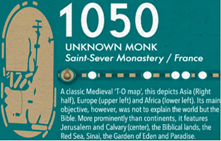
Now although such cartography belief was faulty, its central point belief was the pivot point of all Christian theology – the whole Christian world revolves round the cross of Christ!
In every nation, people of different races, colours, cultures, education, social and economic circumstances still believe Christ’s cross is the centre piece of their theology and eschatology.
a) Those involved with Christ’s cross over 2000 years ago
The gospels breathlessly take us from one scene to another, their final chapters giving glimpses of various figures involved in the scenario of Jesus’ crucifixion…
- Pharisees – leering triumphantly.
- Sadducees –aristocratically scheming.
- Women – tearfully distressed.
- Mary – weeping widowed mother of Jesus.
- Soldiers – just carrying out their duties.
- Passersby –shouters wanting blood.
- Disciples – furtively hiding out of fear.
- Criminals – one mocking, one repentant.
- Peter – follower who boasted he would never betray Jesus, but did.
- Judas – disciple who became Jesus’ betrayer.
- Herod – murderous Roman puppet king.
- Pilate – bored Roman governor whose wife wanted to change his mind.
- Cleopas – simple-minded friend who didn’t understand what was happening.
- Joseph – secret believer from Arimathea, who failed to use his influence.
- Simon – possibly a coloured man from Cyrene (Libya), conscripted to carry Jesus’ crossbar.
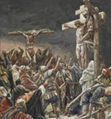
Central to all the action is the quiet, suffering Saviour who was crucified and who is the only reason any of the others are remembered today!
Human nature hasn’t changed – except where the power of the risen Christ has completely changed people… change being one message of the cross!
Note this: Not even the people of that first Good Friday realised the impact the accumulation of their actions and attitudes would have. For example, Paul wrote about the rulers involved, ‘If they had known it, they would not have crucified the Lord of glory’ (1Corinthians 2:8).
Rarely do we understand why we feel the way we do and the full consequences of what we do. Perhaps as we examine scripture we may see something of ourselves in that gathering of onlookers to a Roman punishment – and a Jewish denial of their Messiah.
Let’s look then at some of those who had gathered around the cross (I’m mostly referring to John 19:17-30, encouraging reading what the other gospels say about those involved in the crucifixion of our Saviour) –
1. Pharisees — religious people
Priests, they were born into leadership. Jesus had upset them with His message of loving God, loving your brother and sister as yourself, forgiving your enemies and going and telling the world. Didn’t sound like Jewish law to them.
They didn’t like Jesus and His message! Scripture says they even feared that He would ‘tear down the temple and change all the customs which have come down to us from Moses!’ (Acts 6:14).
They were good, moral men… but legalistic, hard, very proud, and dependent on keeping the traditions.
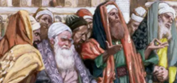
Jesus threatened them because He revealed true religion, demonstrated genuine concern for people and spoke with authority from scripture… not the traditions of human systems. He upset that approach to faith and they quickly decided to do away with Him. Mark 3:6ESV tells that ‘… the Pharisees went out and immediately held counsel with the Herodians against him, how to destroy Him.’
These sins that brought Jesus to the cross challenge us today –
- Are we like the Pharisees?
- Do we think and act in compliance with enforced ‘religious laws’?
- Or are we like Jesus… loving God, loving others, forgiving our enemies, sharing good news?
2. Sadducees — the community leaders
The politicians of that day; an aristocratic party using their money, position and power to perpetuate their own position. They did deals with the Romans ensuring that their own people would be kept subservient to Rome, while they ran the profitable temple trade at huge profit.
Now Jesus came like a breath of fresh air. The captive Jews felt a new racial and religious respect. They wanted to be liberated and to make Jesus their king (John 12:13).

Jesus was a threat to entrenched privilege and power. He strode into the temple and overturned the moneychangers’ tables declaring: ‘It is written in the scriptures that God said: “My temple will be called a house of prayer.” But you are making it a hideout for thieves!’ (Matthew 21:13GNB).
That challenged the power and the wealth of those politicians. There could be no other option. Jesus had to be removed.
Again, here’s a challenge to us today –
- The church of Jesus is neither a political business or profit-making trade!
- Local churches are a family of faith who understand that serving is what servants do.
- Are we loyal servants, not seeking our own gain but serving others – and our Lord’s will?
3. Women — the sympathisers
No more a tragic group of people stood round the cross than those tearful women!
There was Mary, the widowed mother of Jesus. Despite His own suffering He had a comforting word for her, asking His dearest friend John to take care of her (John:19:26-27).
Two other women are mentioned in John 19:25… Mary, the wife of Clopas, and Mary Magdalene. And Mark 16:1 mentions Mary, mother of James and Salome. Matthew 27:56 tells of yet another Mary, the mother of James and Joseph. Also the mother of Zebedee’s sons was there.
Verse 55 tells that ‘Many women were there… They had followed Jesus from Galilee to care for His needs.’ (Many Bible versions call such caring ‘ministering’, some ‘supporting’ or ‘serving).
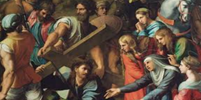
Then there were the women who wept for Him enroute to Calvary along the Via Dolorosa – Way of Sorrows (Luke 23:27). Commentators regard these wailing women as mercenary, insincere mourners who tended dying and death scenarios (see Luke 8:52).
Jesus, who wept for the people of Jerusalem, having foresaw the future destruction of the city by the Romans in 70AD (Luke 19:41-44), turns and speaks to them quite sharply: ‘Women of Jerusalem! Don’t cry for me, but for yourselves and your children!’ And explains why… (Read Luke 23:28-30).
Today Jesus still doesn’t ask for pity but for changed lives… for complete transformation of those who would be close to Him. Sadly it is possible to be close to Jesus in an unsaved manner… and afar spiritually.
The power of the Holy Spirit is the only way that genuine transformation will be effective in our lives! Remember what Jesus said after His resurrection about those who followed Him: ‘… you will receive power when the Holy Spirit comes on you; and you will be my witnesses in Jerusalem, and in all Judea and Samaria, and to the ends of the earth (Acts 1:8).
Church history is replete with many incidents of brave, transformed, Spirit-filled women who would be close to Jesus and follow Him. Not only have they known Him and God’s word, but they have faithfully served their Saviour as missionaries ‘to the ends of the earth’, in local church life and other ways… with the help of the powerful Holy Spirit.
The challenge to us is to know that –
- Jesus is our living Saviour, that His victory over the cross is ours, both women and men.
- He can turn our sorrow into joy. We’re not meant to sympathisers but engaged activists!
- Born again Christians have the Holy Spirit within… and He can enable us to achieve for God.

4. Soldiers — the workers
The soldiers were typical of all the ordinary people whose jobs involved them in the crucifixion of Jesus. They included the Roman soldiers who nailed Him to the cross; the temple guards who arrested Him in the Garden of Gethsemane and had treated him so roughly afterwards.
Then there were the soldier carpenters, tree-fellers and workmen who had made the cross without thinking of their part in the wider crime against humanity. Their defense if brought to the International Criminal Court, would be: ‘We were just following orders, we didn’t decide to kill anyone. That decision came from above.’
In 2Timothy 2:3, Paul directs us to be good soldiers for Christ, pleasing the one who has enlisted us, and not being entangled in sidetracking pursuits. Whoever we are, whatever we do, we should also be involved to sharing the gospel with the lost… and engaged in spiritual warfare against satanic deceits.
The challenge here is to –
- Engage in spiritual battle against sin and Satan as good Christian soldiers.
- Honour Jesus in whatever our secular occupation may be.
- Be faithful to our Saviour, whatever commission He gives us whether we’re ministers or not.
5. Passersby — the bystanders
Crowds of people can change attitude as easily as they change membership. The crowds that roar approval in the sporting stadium can later boo the same players.
On Palm Sunday a crowd gathered in the streets of Jerusalem to cheer the arrival of Jesus. On Good Friday a crowd gathered in the street and roared: ‘Crucify him!’ Different times, different places, different reasons and possibly different crowds.
The point is that bystanders are easily led. Dictators can manipulate the crowds. Crowds can be easily led because they are indifferent to the needs of others, and get carried along with vague promises. Paul’s 1Corinthians 2:8 (above) declaration to leaders applies to crowds too!
Christians today can be bystanders too! Not really interested in what Jesus achieved for us, or the great commission to be a light to others in this dark world that He sets all who call themselves His followers .

Don’t be a bystander, a passerby! Don’t glare – share! God wants us who know the truth and are set free from sin and the devil’s tricks to live the truth, sharing it with others!
Our challenge is to –
- Live for Jesus… involved in our local church’s evangelstic programmes to reach the lost!
- Contribute to the kingdom, both financially to our church and its mission programs!
- Use our natural gifts, experiences, and the Spirit’s assistance to bless others around us.
6. Disciples — the supporters
Of all people, the intentions of the disciples were good. They had left all to follow Jesus, spending three years learning from Him, but… when the crunch came, they each thought they knew better!
Jesus had asked three of them to watch and pray with Him in the garden, but they fell asleep at their prayers. Judas made a deliberate choice to betray Jesus, forcing Him to make a move that led to His crucifixion. And Peter who said he would never deny Him, faced with exposure denied knowing Jesus.
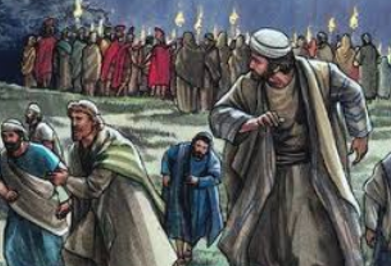
The others too forsook Him and fled. They and Peter had potential… but before the cross, they crumbled. However, when Jesus returned to them in resurrection power, and the Spirit of God had later fallen on them, they became conquerors. Filled with joy, they began telling others. World evangelisation became their mission Their love for Jesus compelled them forward, to move on!
We who follow the way of Jesus are often so weak under pressure. But we who know the scripture know we need the resurrection power of Jesus in such moments… and we receive it!
Our challenge here is this –
- Do not fear when Jesus sets us commissions.
- Know God’s word and promises, the Holy Spirit personally and trust His promises.
- Be overcomers, victors of any challenge… worldly or those that God sets!
7. Criminals – one mocking, one repentant
The two malefactors on crosses alongside Jesus had deserved their punishment for sinning – Jesus didn’t! Around the cross of Christ you can see the sins of –
- Bigotry and immaturity.
- Love of power and position.
- Pride and materialism.
- Self-centredness and indifference.
- Self-pity and gullibility.
- Public apathy.
- The mob spirit.
- Pleasure loving irresponsibility.
- Political expediency.
- Religious intolerance.
Why did Jesus die on Calvary’s cross? These sins, and others, crucified the sinless Son of God! In doing so willingly, He became the Saviour of all humankind! Death and sin were conquered, eternal life was now offered to all who repent of sins, believe in Jesus and accept Him as their Saviour!
This opportunity is open to everyone. One thief crucified along with Jesus foolishly mocked Him, just as the soldiers and others were doing. But ‘the other one made him shut up: “Have you no fear of God? You’re getting the same as Him. We deserve this, but not Him – He did nothing to deserve this.” Then he said, “Jesus, remember me when you enter your kingdom.” He said, “Don’t worry, I will. Today you will join me in paradise”’(Luke 23:39-43Mge).
Here also is a challenge for us –
- Have we been mocking Jesus and Christianity in some way?
- Have we confessed our sins, recent ones?
- Have we placed our future in His hands?
b) Those involved with Christ’s cross today, over 2000 years later
As mentioned at the beginning the cross of Christ is the pivot point of all Christian theology. We especially reverence this at Easter!
Actually, the message of Easter is rather simple – Don’t look for Jesus in all the wrong places! Yes we can picture the cross with Jesus on it. But in reality He’s no longer impaled on it – He’s alive and among His born-again people today, living in our hearts.
One of Jesus’ challenges to His first disciples was ‘Whoever wants to be my disciple must deny themselves and take up their cross and follow me’ (Matthew 16:24). He had said earlier, ‘Whoever does not take up their cross and follow me is not worthy of me’(Matthew 10:38).
It’s often been said that ‘a disciple’s cross’ is whatever task Jesus gives us to carry out, even if pain or inconvenience can’t be avoided. And carrying it throughout our lifespan, aware that tasks and commissions may change as we grow in Christ.
Challenge today for born again Christians –
- We are not to be Pharisees or Sadducees types! Nor Roman soldiers. Neither gawking passersby!
- We’re to be men and women who love our Saviour and are prepared to carry our cross in telling the world about God’s precious John 3:16-17 gift!
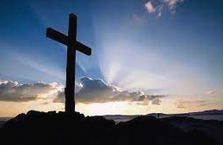
- Where do you stand with the message of the cross? Still gathered at the ‘old rugged cross’ as the hymnwriter called it – or moving on, following Jesus wherever He wants of us in 2024 – and beyond – and doing whatever He wishes of us?
___________________________________________________
Dr Richard Winter pastors The Connection Church, Huntington Beach, California. Link: OnlineConnect@gmail.com
____________________________________________________
 Connecting with You!
Yes, even after all these years the cross is still central, not for an effigy or religious symbol, but for the ‘finished work’ Christ accomplished there, for you, for me for all who will look to and live.