
(April 09, 2024) Brian Bell encourages joyful praise of God with our Christian music…
In his letter to the Ephesians, chapter 5:18-19 (NLT), Paul gives us some advice about living in the Spirit – ‘…let the Holy Spirit fill and control you. Then you will sing psalms and hymns and spiritual songs among yourselves, making music to the Lord.’
And in Colossians 3:16NLT, Paul also encourages our worship along the same lines – ‘Let the words of Christ, in all their richness, live in your hearts and make you wise. Use His words to teach and counsel each other. Sing psalms and hymns and spiritual songs to God with thankful hearts.’
Singing – a Heritage
From my earliest childhood, I was brought under the sound of Christian music. I sang in the children’s choir and later in the church choir. This influence grew when I became a Christian in my mid-teens and began to take a keen interest in the Christian music of my generation.
Along with other young men in the late 1960’s early 1970’s we formed what was then known as a ‘gospel group’ and travelled throughout Northern Ireland singing at evangelistic outreaches to young people. Sometimes we would sing at church services, where not everyone appreciated our music, or songs – some considering playing guitars and drums as bringing ‘the world’ into the church!
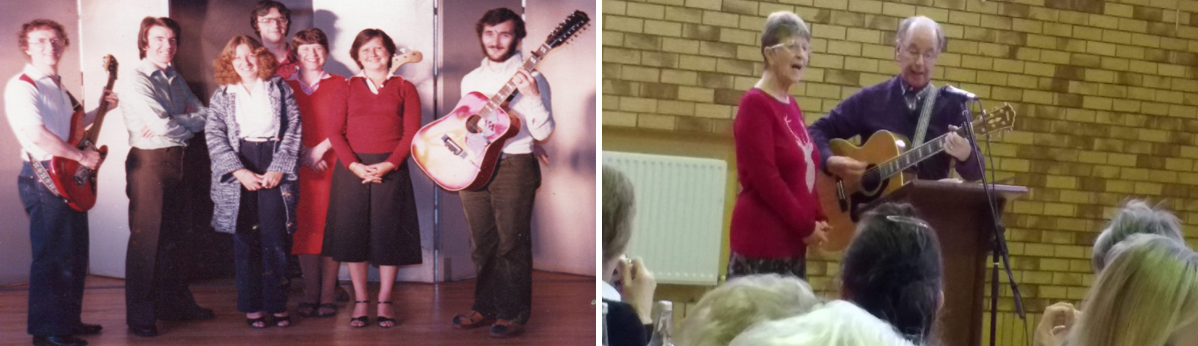
Over the years we reformed (see 1980 group photo below: that’s me, second left). Today I play and sing in my home church music team, along with those two ‘once young men’ on either side of me, Alfie left and George at the rear. Ken, on the right, recently retired from ministry with the Presbyterian church in Ireland.
And, during the course of our married life, my wife Eveline (between the two young ladies, Rosemary left in the photo and Joyce right) and I have had a singing ministry (see 2018 duet photo right).
Singing – a Spiritual Song
Paul’s writings to the believers in Ephesus and Colossae encouraging them to sing ‘psalms, hymns and spiritual songs’ tells me he believed singing was a vital element of Christian fellowship and worship as we still do today.
Now Paul doesn’t give a specific definition… but –
- ‘Psalms’
Refers to the song book of the Jews; the early Christian Jewish believers would already be familiar with them. - ‘Hymns’
This may refer to songs composed by the early believers, a tradition which has continued even in our generation. - ‘Spiritual songs’
These may at first seem a broad description, but although not elaborated on by Paul in his letters may also be seen as a way to define the content of a song.
In respect of the content of a song to be spiritual, I suggest we ask if it has one or more of the following elements (these seven suggestions are not exhaustive, or in order of priority). Does it recognise –
- God as the creator;
- The deity of the Lord Jesus;
- The person and work of the Holy Spirit;
- The all-sufficiency of the Lord Jesus in relation to salvation;
- The sinfulness of man and the need for repentance;
- The truth of God’s word;
- A future life in heaven?
Paul Mallard, in his book The Grace of Gratitude, makes this statement – ‘The test of a good song is that it leads to a clearer vision of the magnificence of God’s glory.’
In Paul’s first letter to the Corinthians, he wrote about food offered to idols which was causing some controversy. A matter on which scripture does not explicitly teach or forbid is usually known as a ‘disputable matter’ about which believers are free to exercise a choice of conscience without condemnation.
Two points here –
(i) What is important about this freedom is that I find my conscience frees me to sing spiritual songs which another person would not, or to use musical instruments while others do not. The choice is ours… but we are not to judge each other.
(ii) Sometimes persons in a high profile position in a Christian organisation who may be called ‘worship leaders’ have been overtaken by sin. Difficult as this may be it does not reflect on everyone else. And – as we must remember – just as the psalmist David, a worship leader who was overtaken by sin, did – if we confess our sin He is faithful and just to forgive our sin.
Singing – in our Worship
I quote again from Paul Mallard – ‘Our singing is not merely incidental…we are not to consider it a necessary preliminary to the sermon, which we view as the real purpose of our gathering for worship. Singing should come from the overflow of our hearts as we gaze on the glory of God and anticipate heaven.’
Bible teacher and author Mike Raiter, speaking about Paul’s encouragement to the Colossians to let Christ’s word dwell in them writes, ‘I would have said something like this: teaching and admonishing one another with regular Bible studies, daily quiet times and hearing lots of great sermons. Of course, these are all very important, but Paul exhorts us to sing.’

When Paul and Silas were unjustly flogged and imprisoned in Philippi, Luke records ‘Around midnight, Paul and Silas were praying and singing hymns to God and the other prisoners were listening’ (Acts 16:25NLT).
Personally, I would love to know what those songs were!
Paul’s exhortation to us about singing is not about ‘feeling good’ – it comes out of a very real experience. Notice, praying and singing are complementary to each other and can have an impact on those who listen.
A song which used to be very popular here in Northern Ireland encourages Paul’s approach –
‘Trust in the Lord and don’t despair, He is a friend so true,
No matter what your troubles are Jesus will see you through.
Sing when the day is bright,
Sing through the darkest night,
Every day,
All the way,
Let us sing! sing! sing!’
Singing for Christian believers is not about escapism, nor for entertainment… but we should not be ashamed to enjoy and be enthusiastic about our singing and music and even applaud those who bring ministry in singing or music.
Singing is not in second place to the reading of scripture, prayer, or sharing a message from God’s word; I see them as co-equal God-given gifts which the Holy Spirit being enabled us with and can speak to us and through us.
In 1Corinthians 12, Paul makes it clear there are different ways of serving in the church and there are different ways God works in our lives. Paul says in verse 7 ‘a spiritual gift is given to each of us as a means of helping the entire church’ and this is what I understand Paul to mean when he says in verse 31 ‘desire the most helpful gifts.’
Singing and music are proven helpful gifts!
Singing – an Eternal Perspective
God has ordained singing to bless and encourage His people. Zephaniah 3:17NLT says ‘He (God) will exult over you by singing a happy song.’
In Revelation 15, John shares a significant event in heaven and in verses 2-3 writes – ‘I saw what seemed to be a crystal sea mixed with fire and on it stood all the people who had been victorious over the beast and his statue and the number representing his name. They were all holding harps that God had given them and they were singing the song of Moses, the servant of God and the song of the Lamb.’
Hymnwriter Eugene M. Bartlett writes in his song I Heard an old, old Story –
‘I heard about a mansion
He has built for me in glory
And I heard about the streets of gold
Beyond the crystal sea;
About the angels singing
And the old redemption story
And some sweet day I’ll sing up there
The song of victory.’

I’m so glad singing and music will be a feature of eternity… although I’m not sure how I will adapt to playing a harp!
_________________________________________________
Brian Bell is a diaconate member, Christ Church (Congregational) Abbots Cross, Northern Ireland. Brian describes himself as ‘grateful for the privilege and opportunity given me to serve my Lord.’
__________________________________________________
 Connecting with You!