
(July 20, 2025) Dr Richard Winter challenges…
Most people I have met realise being known as just a ‘good person’ is not good enough! After all, how does one measure goodness? Is my measurement a universal measurement? Can I apply my measurement to every human being?
The Bible’s measurement of human beings tells us that the human condition is broken and sinful and we can’t do or say enough good things to overcome our broken condition. Therefore we need a Saviour— Jesus Christ!
God’s Amazing Grace
But here’s the good news— God offers us forgiveness of sins through faith in Jesus and what He accomplished on the cross when He died for our sins. That act of kindness and mercy is God’s grace.

The apostle Paul knew and delighted in God’s grace. In 2Corinthians 12:9Mge, he stated, ‘… then He told me, “My grace is enough; it’s all you need. My strength comes into its own in your weakness.”’ In verse 10, Paul added ‘I just let Christ take over!’
He had written in 1Corinthians 15:10NKJV: ‘But by the grace of God I am what I am, and His grace toward me was not in vain.’ We too can learn to embrace God’s grace and receive the forgiveness and help we all need!
Let me share about Paul and his understanding of God’s grace—
1. Paul’s Committed Preparation
God’s grace had very deep meaning to Paul— he used the Greek word charis some 100 times in his epistles.
Following his conversion, Paul spent about ten years in preparation for God’s calling on his life— including three years being personally taught by Jesus Christ (Galatians 1:11-12,17-18). He knew that he was saved by grace and lived by grace. And he knew that he was called by Jesus to testify to the grace of God (Acts 20:24).
Every Christian is charged with the same task: To tell about the grace of God and make disciples! Making a disciple is akin to having a baby— there is birth, child care, training and teaching until adulthood.
Have you ever thought you were ready for ministry… or is ministry left for others to do? A reality here for Christians is that some never think about their preparation for the Great Commission! We should all make ourselves available to God!
Read Acts 13… it’s almost as if Paul was waiting for the other apostles to say it was time for him to ‘get going’.
2. Paul’s Spiritual Calling
Acts 13 tells that while Paul was serving in Antioch Syria when the Holy Spirit spoke to the prophets there— most likely through a word of prophecy (a gift still in operation today: Read 1Corinthians 12-14) announcing that Paul was ready for ministry.
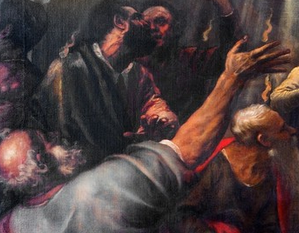
Acts 13:1-3NKJV tell that ‘… in the church that was at Antioch there were certain prophets and teachers: Barnabas, Simeon who was called Niger, Lucius of Cyrene, Manaen who had been brought up with Herod the tetrarch, and Saul [Paul]. As they ministered to the Lord and fasted, the Holy Spirit said, “Now separate to me Barnabas and Saul for the work to which I have called them.” Then, having fasted and prayed, and laid hands on them, they sent them away.’
V13-15NKJV tells the beginning of that missions venture. ‘Now when Paul and his party set sail from Paphos, they came to Perga in Pamphylia … when they departed from Perga, they came to Antioch in Pisidia, and went into the synagogue on the Sabbath day and sat down. And after the reading of the Law and the Prophets, the rulers of the synagogue sent to them, saying, “Men and brethren, if you have any word of exhortation for the people, say on.”’
3. Paul’s Missionary Adventure
This was Paul’s first missionary tour. Along with Barnabas he set out from Antiochto share the gospel. As a point of interest there were two Antiochs… one in Syria and one is Pisidia now modern day Turkey.
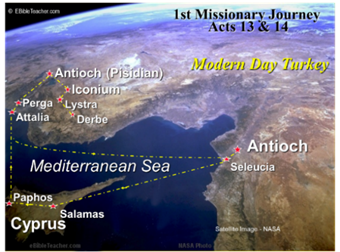
- Three missionary tours are recorded in Acts of the Apostles. Paul’s first missionary trip took about two years to complete (ca. AD 46-48).
- He sailed from the island of Cyprus to several cities in Asia Minor (Turkey) and then back to Antioch in Syria. In total, travelling around twelve hundred miles.
- As already mentioned, Barnabas accompanied Paul and they were later joined by John Mark (who wrote the gospel of Mark).
- Paul’s first convert was Sergius Paulus, the proconsul (governor) of Cyprus (v12)— talk about starting at the top! You should note that you never know who you are going to meet that God has planned for you to bring the good news to.
4. Paul’s Evangelistic Plan
Moving on to Antioch in Pisidia and other centres, Paul would first visit the synagogue and minister to Jews, preaching ‘faith over works’ because of his Jewish brothers inability to understand Jesus.
Now the Jews prided themselves on their obedience to the law— faith had become secondary to obedience in Jewish culture. It was a case of ‘We do what Moses had taught… that’s the way it’s to be done: you better read and practise every one of the 613 mitzvot (commandments Moses taught)— and pity help you if you disregard this teaching!’
- So, Paul started by teaching from the beginning of scripture, before Moses or the big Ten Commandments or for that matter any of the religious, civil or food laws given to Israel.
- His plan was to teach that God’s laws are a guide to righteous living— thatbefore you become a law keeper something within you must be switched on to God.
- That every heart must be like Abraham’s— ready to receive God’s instructions. So here’s the ‘New News’, my brother Jews… and the correct understanding of the ‘Old News’— we Jews are accepted by God through faith in Jesus Christ, not obedience to the law!
No doubt Paul would have expressed great truths such as he wrote to the Christians in Rome: ‘There is none righteous, no, not one’ (Romans 3:10b) and ‘… all have sinned and fall short of the glory of God’ (Romans 3:23). And that as he reviewed Jewish history, he reminded them that Jesus was a descendant of David, and introduced them to the message of grace.
That ‘From this man’s [David] seed, according to the promise, God raised up for Israel a Saviour— Jesus … Therefore let it be known to you, brethren, that through this Man is preached to you the forgiveness of sins; and by Him everyone who believes is justified from all things from which you could not be justified by the law of Moses’ (Acts 13:23,38-39NKJV).
Verse 43 records that ‘… when the congregation had broken up, many of the Jews and devout proselytes followed Paul and Barnabas, who, speaking to them, persuaded them to continue in the grace of God.’
5. Paul’s Grace Centredness
Scripture explains grace as God’s unmerited favour and His undeserved kindness. It’s what God does for us, not what we do for God!
Paul’s letters are known for their emphasis on God’s grace as a central theme. He even prophesied to the Ephesian church that: ‘… in the ages to come He [God] might show the exceeding riches of His grace in His kindness toward us in Christ Jesus. For by grace you have been saved through faith, and that not of yourselves; it is the gift of God, not of works, lest anyone should boast’ (Ephesians 2:7-9).
Actually the word grace (or some form of it) appears 185 times in scripture… such as the following: The first time the Bible mentions grace is in Genesis 6:8NKJV— ‘But Noah found grace in the eyes of the Lord.’ The last time is in the final verse of the Bible: ‘The grace of our Lord Jesus Christ be with you all. Amen’ (Revelation 22:21NKJV).
(i) Grace is one of the key attributes of God, explaining what is God like—
‘The Lord is gracious and full of compassion, slow to anger and great in mercy’ (Psalm 145:8).
(ii) Grace is God among us, personified in Jesus—
‘And the word became flesh and dwelt among us, and we beheld His glory, the glory as of the only begotten of the Father, full of grace and truth … For the law was given through Moses, but grace and truth came through Jesus Christ’ (John 1:14,17).
(iii) Grace is the basis for our salvation through faith in Jesus Christ—
Ephesians 2 above and ‘… if by grace, then it is no longer of works; otherwise grace is no longer grace’ (Romans 11:6).
(iv) Grace doesn’t mean the law of God is without merit—
Paul understood that there is a purpose of the law and the moral code is still intact… it explains God’s righteous standard. He pointed out that he ‘… would not have known sin except through the law. For I would not have known covetousness unless the law had said, “You shall not covet”’ (Romans 7:7b).
(v) Grace exposes our sinful condition—
The writer of Hebrews proclaimed, ‘For the word of God is living and powerful, and sharper than any two-edged sword, piercing even to the division of soul and spirit, and of joints and marrow, and is a discerner of the thoughts and intents of the heart’ (Hebrews 2:12).

It expresses our need for a Saviour because we know we have done wrong— whether big or small— and Paul taught ‘Therefore the law was our tutor to bring us to Christ, that we might be justified by faith. But after faith has come, we are no longer under a tutor’ (Galatians 3:24-25).
‘Tutor’ translates to pedagogue, which was a person tasked with caring for a child, including walking the child to school. Pedagogues connected children with educational instruction as the law connects our hearts to the heart of the Saviour. A good teacher takes us beyond the rules of language or mathematics it introduces us to how they may be used for the good of all.
God’s Grace Perspective
Distinguished art critic Robert Cumming once stood in London’s National Gallery gazing at Italian Renaissance master Filippino Lippi’s fifteenth-century depiction of Mary holding the infant Jesus on her lap, with saints Dominic and Jerome kneeling nearby.

There could be no doubting Lippi’s skill, his use of colour or composition… but the painting troubled Cumming—
- Proportions seemed slightly wrong.
- The two kneeling saints looked awkward and uncomfortable.
- Background hills seemed exaggerated, as if they might topple out of the frame at any minute onto the gallery’s polished floor.
Cumming wasn’t the first to criticise Lippi’s work for its poor perspective… but he may well be the last to do so, because at that moment he had ‘a revelation.’ It suddenly occurred to him that the problem might be his.
- The painting had never been intended to come anywhere near a gallery.
- Lippi’s painting had been commissioned to hang in a place of prayer— a chapel!
The dignified critic dropped to his knees in the public gallery before the painting. He suddenly saw what generations of art critics had missed. From his new vantage point, Cumming found himself gazing up at a perfectly proportioned piece.
The foreground had moved naturally to the background, while the saints seemed settled – their awkwardness, like the painting itself, having turned to grace. Mary now looked intently and kindly directly at him as he knelt at her feet between saints Dominic and Jerome.
It was not the perspective of the painting that had been wrong all these years, it was the perspective of the people looking at it. Robert Cumming, on bended knee, found a beauty that Robert Cumming the proud art critic could not. The painting only came alive to those on their knees in prayer. The right perspective is the position of worship.
God’s Redemptive Grace
I began this article talking about ‘being a good person.’ But being a good person won’t save us! We are saved only through a personal relationship with Jesus.
John Newton, a former slave trader who found redemption in Christ and wrote the hymn Amazing Grace, near his death said, ‘My memory is nearly gone, but two things I remember: One, I am a great sinner, and two, God is a great Saviour.’
- We too must have the right perspective on ‘Grace’ through Christ’s redemptive work.
- We need to bend a knee to see and understand what God has done for us through Christ.
- Reading the Bible is like looking at great art… some explanation is necessary for us to understand.
- That’s why we come to church… to hear more of God’s great story of love and forgiveness.
- I encourage you all to fully embrace God’s amazing grace— and let Christ take over!

_________________________________________________
Dr Richard Winter pastors The Connection Church, Huntington Beach, California. Link: OnlinerConnect@gmail.com
_________________________________________________
 Connecting with You!
Loved the challenging story about art critic Robert Cumming and his ‘grace given’ perspective. We all need that perspective of grace to help us see every day!