
(February 05, 2024) Dr Jim McClure challenges…
I have been reflecting lately on the unexpected journey my life has taken over the years and I would never have guessed the direction it would take. It truly has been an amazing journey of discovery on roads that have been generally unplanned.
Life can be compared to a journey. Sometimes the road resembles a journey down a 6-lane motorway and sometimes it is more like travelling down an unsealed, pot-holed lane.
In my last article, A Road Untravelled, we considered the account of the miraculous crossing of the Jordan river by the Israelites who were leaving their wilderness wandering of 40 years to begin the challenge of a new life in Canaan.
Of course, their journey did not end when they entered Canaan – they had many other roads ahead of them as they settled in, such as this one…
Shortly after they had entered the Promised Land, they encountered their first roadblock in the form of the city of Jericho.

Considered to be one of the oldest cities in the world, it was rich in resources and its location was strategically important as it controlled the routes between north, south, east and west. Jericho was also one of the world’s first walled cities. And what walls they were!
The retaining wall around it was about four metres high, and on top of that was a mudbrick wall around two metres thick and about seven metres high. We are talking about very big, substantial walls built on a slope and thus making it almost impossible to be overrun by an enemy.
Nevertheless, the people of Jericho, who were aware of the approach of the Israelites, were getting nervous. They knew that, despite the secure defences around the city, the vast number of Israelites posed a threat. Joshua 6:1 tells that ‘Jericho was tightly shut up because of the Israelites. No one went out and no one came in.’
1. The Project
When the Israelites had crossed the Jordan river into Cannan, they were aware that this was the first step in the journey to occupy the land which God had promised them. Moses had reminded them of the challenge God had given them, ‘See, I have given you this land. Go in and take possession of the land that the Lord swore He would give to your fathers’ (Deuteronomy 1:8).
The first steps of their journey led them to the apparently impregnable city of Jericho – it was a ‘roadblock’ that had to be overcome before they could advance any further.
Their project was quite clear – overthrow Jericho. But how? Jericho was a massive obstacle that obstructed the journey. They had experienced some battles against various tribes during their 40 years in the wilderness but attacking Jericho posed wholly different problems at many levels.

And that was the challenge with which they were confronted, truly a major roadblock to their ambitions to spread throughout this new land.
Jericho’s inhabitants were also anxious… concerned about the possibility of an attack by the sheer number of Israelites and concluded that it was better not initiate any attack on them. Joshua 6:1 tells that ‘… Jericho was tightly shut up because of the Israelites. No one went out and no one came in.’
Notice this – even before any steps were taken to engage in a war with Jericho, God told Joshua, ‘I have delivered Jericho into your hands, along with its king and its fighting men’ (Joshua 6:2). The roadblock of Jericho had to be removed, and when God confirmed that the result was not in doubt, He was speaking as if the battle had already been won even though it had not even begun!
God would assuredly work out His purpose – but Israel also had a role to play.
That tells us three things –
(i) When we obey God and take the path in life in which He has directed us, His plan for us will certainly be accomplished – even if we are unable to see how it possibly could be. I know that in my own life time and time again what appeared to be impossible goals became realities.

(ii) Even when we are obediently walking in the direction God has given us, everything will not always work out smoothly. God doesn’t promise us a journey in which we will be ‘happy all the day, singing all the way.’ The reality of life soon teaches us that lesson. Obstacles have to be surmounted, challenges have to be overcome and battles have to be fought.
(iii) Obstacles that stand in our way can become opportunities as we move forward in our walk with God. When God said to Joshua that He had delivered Jericho into his hands, He was assuring him that He (God) was in control and that the ending was assured. The project would be accomplished.
2. The Plan
To overcome Jericho the Israelites needed a battle plan. Despite their numbers, a full-frontal attack in which they would attempt to overcome the powerful defence at Jericho, would not have appealed to the Israelites. But God gave Joshua a plan which he shared with the people. And what a strange plan it was…
i. Soldiers had to march around Jericho in silence once a day for six days.
ii. Seven priests, each carrying trumpets made of rams’ horns, were to walk in front of the ark.
iii. On the seventh day, soldiers and priests were to march around Jericho seven times while the priests blew their trumpets.
iv. The people were to remain silent while all this was happening until the seventh day when the priests would give a long blast on their trumpets.
v. All the people would then give a loud shout.
vi. The mighty walls of Jericho would collapse and the people of Israel would rush in.

I wonder what they all thought of this battle plan. Certainly it was unique! And frankly, it must have sounded so odd that people probably looked at each other in amazement when they heard it. There had never been a battle plan like this before nor since!
To their credit the Israelites followed the plan but it would not surprise me if some of them muttered, ‘What a silly idea! What good is that going to do?’ But everything worked out exactly as Joshua’s had described because it was God’s plan!
In Isaiah 55:9 God states, ‘As the heavens are higher than the earth, so are my ways higher than your ways and my thoughts than your thoughts.’ God’s ways are higher than our ways because He sees the bigger picture and know His bigger plan. His plans for our lives, however unexpected or unusual they may appear to be, are always the best plans to follow. In Isaiah 46:10 God said, ‘My purpose will stand, and I will do all that I please.’
Trust Him in all things. He always knows what He is doing and His plans never fail. If we belong to Him, our future is secure.

3. The Problem
This account of the battle of Jericho is inspiring at many levels. However, there is one part of the account that raises some problems…
Verses 17 and 21 say, ‘The city and all that is in it are to be devoted (literally, ‘destroyed’) to the Lord. Only Rahab the prostitute and all who are with her in her house shall be spared because she hid the spies we sent. … They devoted the city to the Lord and destroyed with the sword every living thing in it – men and women, young and old, cattle, sheep and donkeys.’
Those are very serious words. It is tempting to skip over these verses and focus only on all the positive things found in this chapter. But those verses in particular call for some comment.
Did God really command that every person and every animal in the city should be killed apart from Rahab and her family? Well, that is what it says. Following the horror of the invasion of Israel by terrorists on October 7 last year the horror of such acts impacts us deeply. On that day obscene acts of brutality were inflicted on innocent men, women and children 1,139 people were killed and 250 Jews were taken into Gaza as hostages.
Is what happened in Jericho back then any different from what happened in Israel on October 7? Did God really command acts of genocide against innocent men, women, and children in Jericho?
(i) Accusation of God’s cruelty
Various critics of Christianity have argued that the Old Testament often portrays God as a vicious and vindictive monster. They say that the account of the flood in Genesis supports that assessment for God said to Noah in Genesis 6:13, ‘I am going to put an end to all people, for the earth is filled with violence because of them. I am surely going to destroy both them and the earth.’ And they claim that the destruction of Sodom and Gomorrah in Abraham’s day also reveals the cruel character of God. And that God’s instruction to Joshua to utterly destroy Jericho reinforces the merciless character of God.
However, such accounts in the Old Testament reveal that such a response from God is associated with extremely sinful behaviour in societies. God does not allow the works of evil to triumph. At the right time He takes action against it.
(ii) Affirmation of God’s character
Moses summarised God’s character in these words, ‘He is the Rock, His works are perfect, and all His ways are just. A faithful God who does no wrong, upright and just is He’ (Deuteronomy 32:4).
We know that when Israel first entered Cannan, the inhabitants there were morally corrupt and practised child sacrifice and ritual prostitution. In the destruction of Jericho we clearly see God’s verdict on sin. In Isaiah 13:11 God has stated, ‘I will punish the world for its evil, and the wicked for their iniquity; I will put an end to the pride of the arrogant and lay low the haughtiness of the ruthless.’ God does not allow the works of evil to triumph. At the right time He takes action against evil.
Let’s not make the mistake of trivialising God. His acts of judgment must not be seen as vindictive acts of cruelty nor must His mercy be seen as softness. When Abraham asked God, ‘Will not the Judge of all the earth do right?’ (Genesis 18:25) he knew that the answer was, ‘Of course He does.’ Our human perspective on all things is clearly very limited but the Lord God Almighty sees the big picture on all things at all times and His judgment is always right! So trust Him!
4. The Purpose
The ‘roadblock’ of Jericho with which the Israelites began their task of settling in the Promised Land was a major learning experience for them. Their 40 years in the wilderness and then crossing of the Jordan river would have been all for nothing if they had been blocked at their first obstacle.
The whole incident reveals three things:
(i) Declaration of faith
Confronted by an apparently impenetrable obstruction, the Israelites received from Joshua the instructions he had received from God but which were a wholly unusual battle strategy. Were they prepared to follow those instructions that required their soldiers to walk around the city for seven days accompanied by priests blowing trumpets and then, finally, for everyone to give a loud shout. Would that really see the solid walls of Jericho reduced to rubble?

Could this strange advice from God really be trusted? It took an act of faith on the part of the Israelites to believe that such a strategy would work!
In Hebrews 11:30 we read, ‘By faith the walls of Jericho fell, after the people had marched around them for seven days.’ Does our faith truly affect the way we live today?
(ii) Demonstration of obedience
Having seen God opening a way through the Jordan river just a few days earlier, the Israelites were prepared to take God at His word again and the plan was implemented.

Only God could work the miracle… but the Israelites were also given a role to play. God gave them instructions and they obeyed! They demonstrated their obedience by following His instructions preciously!
But it was neither their marching, or trumpet blowing or shouting that brought down the walls – it was God who did all that in response to their obedience. They had a part to play in the defeat of the city and they rose to occasion. We also today have a part to play as God works out His purposes in our world. Passivity has no place in the Christian’s discipleship.
(iii) Display of God’s power
Can you imagine the look on the faces of the Israelites when, after they had given their loud shout, the walls of Jericho tumbled down and disintegrated into rubble?

But it was not their shout that caused the collapse – it was the mighty power of God at work. How astounding that must have been. They would have been awestruck when they had seen God’s power displayed at the Jordan river and once again they were witnessing dynamic power of God at work.
This was the God they believed in. This is the God we also believe in. He has not changed. His faithfulness has not changed. His power has not changed. We can trust Him.
God’s forgiveness and blessing
One other person played a role in the victory over Jericho. She is mentioned in Joshua 6:25, ‘But Joshua spared Rahab the prostitute, with her family and all who belonged to her, because she hid the men Joshua had sent as spies to Jericho – and she lives among the Israelites to this day.’
It comes as a bit of a surprise to discover Rahab receiving a special mention. Not only was she a Canaanite but a prostitute… yet she was spared when Jericho was destroyed.
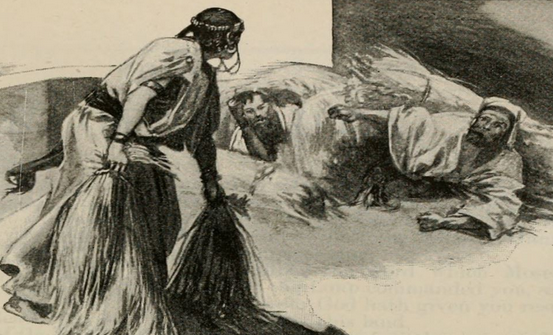
Why did she not die with the other residents of Jericho? Because she had become a woman of faith in God. We read more about her in Joshua 2:4 where we learn that she had hidden the two spies Joshua had sent to Jericho before they crossed the Jordan. Because she also put her faith in the God whom they trusted, she did not perish when the walls of Jericho fell.
Yes, there were various things about her that were not admirable but longing for a new life, she had placed her faith in Israel’s God and her actions demonstrated that faith.
Hebrews 11 is a wonderful chapter in the New Testament. It is a kind of portrait gallery of some of the great characters of faith who are mentioned in the Old Testament and it includes such people as Abraham, Joseph, Moses, Gideon, Samson, David, Samuel and many others. And unexpectedly the name Rahab also appears.
In verse 31 we read, ‘By faith the prostitute Rahab, because she welcomed the spies, was not killed with those who were disobedient.’
Her faith may have been very limited and not very well informed, but she nevertheless trusted God and clearly grew in that faith. She is also mentioned in Matthew 1:5 as an ancestor of Jesus Christ. God had freely forgiven her for her sins and brought her into His family and gave her eternal life.
Challenge
Do you know Him? Jesus clearly revealed the loving heart of God for humankind and His yearning for us to turn to Him, love Him and live for Him. The only way truly to know God and trust Him is through Jesus Christ.
Jesus said, ‘God so loved the world that He gave His one and only Son, that whoever believes in Him shall not perish but have eternal life. For God did not send His Son into the world to condemn the world, but to save the world through Him’ (John 3:16-17).
What ‘Jericho’ do you need to win victory over to move ahead into whatever ‘promised land’ God has for you?

____________________________________________
Dr Jim McClure, author of several books and Bible studies, offers them free in electronic version in EPUB, Kindle and PDF formats.

Looking for Answers in a Confusing World is particularly recommended. Questions seeking enlightenment on biblical perspectives are welcomed. Link: jbmcclure@gmail.com
____________________________________________
 Connecting with You!
Thank you Jim, I fully agree with your description of how the journey of life may take unplanned or unexpected routes because it also reflects my experience. Yet as you say, in all of this we have a God who can be trusted. Thanks also for not shying away from the ‘tough’ question, God is wholly just, not cruel or merciless, as the ‘redemption’ of Rahab and her family demonstrates.