
(November 06, 2024) Dr Jim McClure shares…
The Old Testament has a collection 12 books called the ‘Minor Prophets.’ They are named ‘Minor’ not because they are unimportant but because they are short, the shortest of all being ‘Obadiah,’ also the shortest book in the Old Testament. Consisting of only one chapter of 21 verses it is easily ignored as not being particularly important.
However, rather than being ‘unimportant’ it is, in fact, a hidden gem but admittedly it can be difficult to follow without knowing the following underlying facts.
1. Person
Who was Obadiah?
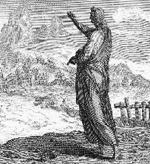
The name means ‘servant of the Lord.’ There are 13 different people in the Old Testament who are called by that name and we know very little about the one who wrote this book.
Also we are not entirely sure when he lived, although it is most likely that he was a contemporary of Jeremiah in the 6th century BC and witnessed the violent attack on Judah by the Babylonians.
2. Past
Obadiah’s prophecy concerns the nations of Judah and Edom which lay south of present-day Israel. Edom was a mountainous region of red rock formations which includes the area of the red sandstone city of Petra (which was built at a later time.)
The significance of Obadiah’s message can only be grasped when we understand the shared family history of both the people of Israel and the people of Edom. Both nations traced their ancestry back to Abraham whose son Isaac was the father of the twins Esau and Jacob. In Genesis 25 we read that even before they were born, they struggled together in the womb— which was a kind of foreshadowing of what was to come in the future.
Before they were born, God said to their mother, Rebekah, ‘Two nations are in your womb, and two peoples from within you will be separated; one people will be stronger than the other, and the older will serve the younger’ (Genesis 25:23). Then in verse 25 we read, ‘The first to come out was red, and his whole body was like a hairy garment; so they named him Esau.’
In Hebrew ‘esau’ means ‘hairy’, which to us may seem to be a rather odd name to give to your son! We notice also that his hair was reddish in colour, consequently, he was given the nickname Edom, which is the Hebrew word for ‘red.’
As the second son was being born, he was holding tightly to his brother’s heel and his parents named him ‘Jacob’ which in Hebrew means ‘heel catcher.’ Obviously a very appropriate name but not one which most parents would choose!
As the brothers, ‘Red’ and ‘Heel-catcher’ grew up, it was evident that they were not only very different in appearances but also different in temperaments and personalities. Esau was the outdoors type who enjoyed activities such as hunting while Jacob preferred to stay at home and be pampered by Rebekah his mother.
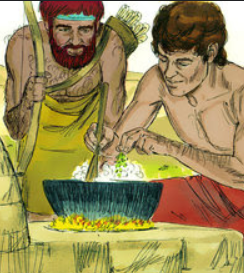
The Bible reveals that Jacob as a man with many flaws— particularly, he was deceitful and cunning. He slyly got hungry Esau to give him his birthright which included a double portion of the inheritance and leadership of the family after their father died (Genesis 25:29-33) for some food. Later, with Rebekkah’s encouragement, Jacob, pretending to be Esau, deceived his old, blind father, Abraham, into giving him the blessing, which was a confirming of the birthright that had been Esau’s right to receive (Genesis 27).
When Esau discovered the dishonest manoeuvring that had taken place, inevitably he was furious. He said to his father, Isaac, ‘Isn’t he rightly named Jacob? He has deceived me these two times: He took my birthright, and now he’s taken my blessing!’ (Genesis 27:36). Esau was so angry that he planned to kill Jacob after their father died.
Rebekah was aware of Esau’s angry intent and she advised Jacob to flee from their home in Beersheba to the home of some of his mother’s relatives who lived in Haran which was about 800 kms away. The Message Bible graphically renders her advice to Jacob— ‘Son, listen to me. Get out of here. Run for your life to Haran, to my brother Laban’ (Genesis 27:43).
That journey unexpectedly was the turning point in Jacob’s life for when he stopped at a location to spend the night, he had a dream that was to change not only his life but also ultimately to affect the whole world. After his long journey he lay down and fell asleep. He had a spectacular, God-given, life-changing, dream. In his dream he saw a staircase reaching from earth to heaven with angels ascending and descending.
God promised him that He would bless him and his descendants. When he awakened, he said , ‘The Lord is here! He is in this place, and I didn’t know it!’ (Genesis 28:16GNB). Jacob named that place Bethel which means ‘House of God.’
It was a life-changing experience for Jacob whose name was changed by God to Israel, which means ‘struggler with God.’ During his life Jacob had many struggles which he overcame and through him the nation Israel came into being.
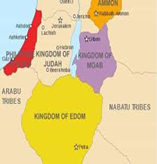
When he returned home after about 20 years, he and Esau had an unexpectedly friendly reunion. However, that reconciliation did not carry through to Esau’s descendants. Following Isaac’s death we read that Esau and his family ‘moved to a land some distance from his brother Jacob. … So Esau (that is, Edom) settled in the hill country of Seir’ (Genesis 36:6,8). The region became known as Edom and the territory the Edomites occupied stretched across areas from the south of Dead Sea into present-day Jordan.
As the centuries passed, despite the family connection between the peoples of Edom and Israel, the relationship between them was contentious as the hatred of the Edomites for Israel fermented.
For example, centuries later, when Moses led the Israelites from their captivity in Egypt, they arrived at the outskirts of Edom and asked permission to pass through. The king of Edom twice refused the request and said, ‘You may not pass through here; if you try, we will march out and attack you with the sword’ (Numbers 20:18). Moses then led the Israelites on a route that avoided conflict with the Edomites.
By the time of the prophet Obadiah the tension had radically increased between Judah and Edom and the Babylonian invasion of Judah was exploited by the Edomites who considered that it was to their advantage to see the destruction of Judah.
When Obadiah lived, that is, in the 6th century BC, it was a horrendous period in the history of Judah as the mighty armies of Babylon invaded all the regions of Judah and deported thousands of its citizens and then turned their focus on the walled city of Jerusalem and ferociously attacked it.
Eventually the Babylonian army was victorious and the city walls were razed to the ground, the magnificent temple that Solomon had built around 400 years earlier was turned to rubble and all the precious and sacred treasures were removed, thousands were killed and thousands more were deported to Babylon.
3. Prophecy
The prophecy of Obadiah was given shortly before that final attack by the Babylonians. However, the people who first heard the prophetic message were aware of Edom’s long history of hostility towards Judah. About 150 years before this prophecy was given, in the reign of King Ahaz, we read in 2Chronicles 28:17, ‘The Edomites had again come and attacked Judah and carried away prisoners.’ This was an ongoing hostility.
In giving this prophecy Obadiah was not just stating his own personal assessment of the political situation but rather he made it clear that this was a message from Almighty God Himself! Obadiah began with these words, ‘This is what the Sovereign Lord says about Edom— “We have heard a message from the Lord.”’ And that message dealt with some very significant issues.
4. Pride
In Obadiah’s first three verses of we read that God denounced the arrogance of the Edomites who thought of themselves as being invincible.
(i) Example of Edom
God’s rebuke began with— ‘The pride of your heart has deceived you, you who live in the clefts of the rocks and make your home on the heights, you who say to yourself, “Who can bring me down to the ground?”’ (v3). As the Edomites lived in a mountainous area that was geologically higher than Judah, they literally looked down on the land of Judah and they also figuratively looked down on the people of Judah whom they totally despised. The Edomites believed that they were invincible and therefore, thinking that they were so much better, so much stronger, so much safer than their enemies, they were confident of their absolute superiority. They rejoiced in their pride!

That is what pride does— it exaggerates our opinion about ourselves. And how easily we as individuals can be caught up in such self-deceit. Pride feeds a distorted image. It produces smugness and false confidence. The great irony here is that Edom’s pride about its strength blinded them from seeing its weakness.
Pride is not the same as self-esteem. Self-esteem is about having a grasp of one’s own self-worth. That is wholly appropriate. We need to recognise that each of us is precious to God. King David wrote, ‘For you created my inmost being; you knit me together in my mother’s womb. I praise you because I am fearfully and wonderfully made; your works are wonderful; I know that full well’ (Psalm 139:13-14). And Paul reminds us in Ephesians 2:10 that ‘we are God’s handiwork, created in Christ Jesus to do good works.’ Recognising our self-worth is an emotionally healthy place to be.
But when self-worth changes to pride, it becomes personally destructive! Pride is about self-interest and it produces a sense of superiority and arrogance which is manifested in various ways. It—
(a) Seeks the admiration and envy of others.
(b) Creates an distorted image of ourselves, making us believe we’re better than others.
(c) Obstructs our receiving God’s grace because we think that we can cope very well without it.
Pride elevates us and puffs us up and, while our focus is on us, we take our focus off God! In stark contrast to the pride and arrogance of Edom we see in the teaching and example of Jesus true humility. Humility is not a characteristic with which we are born. It is a choice that we make which, in many ways and at various times, goes against our inclinations.
We sometimes view humility as weakness when, in fact, it is remarkable strength. Someone has made this observation, ‘Humility isn’t thinking less of yourself, it’s thinking of yourself less.’ How true this is!
(ii) Example of Jesus
In the whole of His ministry, from His birth in a stable to His death on a cross, Jesus gave a perfect example of living in humility. Here’s the point: when the King of Kings and the Lord of Lords came to earth, He not only preached a message of humility but also lived a life of humility.

This is the point Paul was making in Philippians 2:3-8 when he wrote: ‘Do nothing out of selfish ambition or vain conceit, but in humility consider others better than yourselves. Each of you should look not only to your own interests, but also to the interests of others. Your attitude should be the same as that of Christ Jesus, who, being in very nature God, did not consider equality with God something to be grasped, but made Himself nothing, taking the very nature of a servant, being made in human likeness. And being found in appearance as a man, He humbled Himself and became obedient to death— even death on a cross!’
The challenge before each of us is this— how do we choose to live? Are we going to let pride determine our character and behaviour or are we going to embrace the challenge of humility?
5. Penalty
After Obadiah revealed God’s rebuke of Edom’s pride, he then declared God’s penalty on Edom: ‘Though you soar like the eagle and make your nest among the stars, from there I will bring you down.’(v4). Then God went on to say, ‘Oh, what a disaster awaits you …’(v5) adding, ‘… will I not destroy the wise men of Edom, men of understanding in the mountains of Esau?’ (v8). And, ‘Because of the violence against your brother Jacob, you will be covered with shame; you will be destroyed forever’ (v10).
For about 20 years the Babylonian army had been brutally attacking and suppressing Judah and deporting thousands of its citizens. During that time the Edomites had given support and encouragement to the Babylonians. They even exploited the situation by invading Judah, brutally treating and killing many Jews and laying claim on their property.
Following a 2½ year siege of Jerusalem in 586 BC the city was overrun by Babylonians. It was totally destroyed and its people were deported to Babylon. But 70 years later, the Persian emperor Cyrus permitted the Jews to return to Jerusalem and rebuilt the city and the temple.
Obadiah had confidently declared that the day would come when Edom would be wholly defeated. That promise was filled a few decades later when Edom was attacked by an Arabian tribe called Nabateans. Historical records show that Edom was wholly defeated, never to rise again and the Edomites, as a race, no longer existed. Thus, Obadiah’s prophecy concerning Edom was fulfilled. God had done what He had said He would do!
- God’s word is ever sure and His promises are always dependable.
6. Promise
In verses 15-21 a significant change of emphasis takes place. Obadiah shifted his focus to include all nations— ‘The day of the Loris near for all nations. As you have done, it will be done to you; your deeds will return upon your own head’ (v15). There is a promise of judgment on all nations and all people. No one shall avoid it.
This passage affirms that God is the God of all history. Someone has coined the phrase that history is ‘His story’ and in many ways this is true. Despite all the corruption and the violence that has shaped our world, through it all God is working out His purposes. The hymn God is Working His Purpose Out magnificently expresses it in these words,
‘God is working this purpose out, as year succeeds to year;
God is working this purpose out, and the time is drawing near;
Nearer and nearer draws the time, the time that shall surely be:
When the earth shall be filled with the glory of God as the waters cover the sea.’
The final verse of Obadiah’s prophecy declares, ‘Deliverers will go up on Mount Zion to govern the mountains of Esau. And the kingdom will be the Lord’s.’
Biblically the words ‘Mount Zion’ are used to represent the dwelling place of God. And in the New Testament the name ‘Mount Zion’ is used symbolically to refer to the eternal presence of the Lord God Almighty.
- Obadiah reminds us that we can have confidence that the future is in God’s hands.
- Despite the violence and corruption in our world today, we don’t need to be crushed by it.
- In Obadiah’s final words we find God’s promise of deliverance, His promise of salvation, His promise of His eternal presence with His people.
Obadiah finishes his prophecy with the triumphant statement, ‘The kingdom will be the Lord’s.’ Hallelujah! God will be triumphant and He invites us to share in that victory when Jesus returns.
By faith in Jesus, all who love the Lord and enthrone Him as Lord of all, will rejoice in that glad day when He returns and then we shall forever be with the Lord.

____________________________________________
Dr Jim McClure, author of several books and Bible studies, offers them free in electronic version in EPUB, Kindle and PDF formats. Questions seeking enlightenment on biblical perspectives are welcomed.

Particularly recommended— Looking for Answers in a Confusing World
Link: jbmcclure@gmail.com
___________________________________________
 Connecting with You!
Another great meditation full of challenge and encouragement from Dr Jim.
I agree there is much ‘PROFIT’ for me/us today to consider in the words the Lord spoke through Obadiah.